

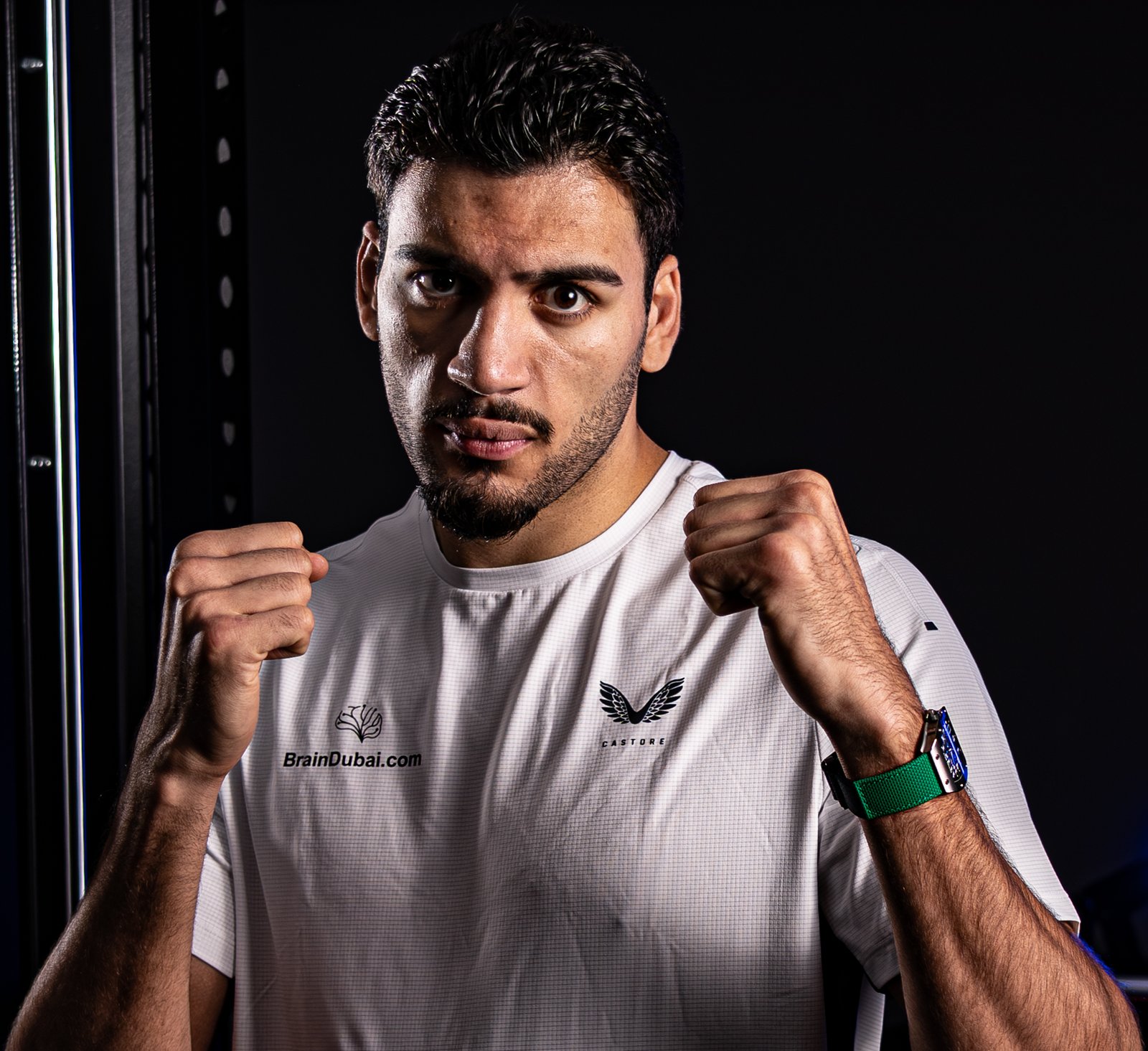
The UK boxing prodigy talks to Esquire Middle East about the streets that shaped him, the losses that defined him, and the mindset that’s propelling him to the top of the global stage.
You’ve gone from Ilford to Riyadh to New York. What’s the version of you that steps into the ring now, compared to the one who started this journey?
I’m not the same fighter I was when I started out. I’ve learned patience, how to think before I move, how to stay calm when everything’s loud around me.
Ilford built that into me. It gave me grit and resilience. People see the way I carry myself now and think it’s always been like that, but that polish only came after years of fighting for everything. My dad was in prison back then, and I’d travel to Belgium to see him, then come home and train like my life depended on it because it did.
Every time I drive through Ilford, I see the roads I used to run as a kid, chasing something I couldn’t explain. I ran that same route recently after coming back from New York. It hit me how far things have come, from those streets to global arenas. That’s what staying the course does.
Riyadh gave me belief. It showed me what’s possible, the energy, the stage, the scale of it all. It’s the place where I see myself headlining, not just in boxing, but in everything I stand for.
And New York, that city changes your mindset. The pace, the people, the constant movement, it forces you to dream bigger and push harder.
Through it all, I’m still that same kid from Ilford, just sharper, calmer, and more focused.
Boxing careers often hinge on timing: who or what has helped you know when to push, pivot, or start over?
Timing’s everything in this game. I’ve learned to listen to my coaches, my instincts, and sometimes, to silence. When you stay in a state of stillness, the right moment always reveals itself. And as a man of faith, I believe nothing happens too early or too late. God’s timing is the best timing.
My coach keeps me grounded when things get noisy. He’s been through it all, so when he speaks, I listen. And my mum, she’s the heart of everything. She’s taught me discipline, grace, and to never lose sight of who I am. We talk every day; she’s my compass.
One of the biggest lessons has been learning to trust myself. After the Adames fight, everyone had an opinion. People told me not to take the Berlanga fight, but I saw something they didn’t. Sometimes the vision’s yours alone, and you have to back it even when others don’t see it yet.
And then there’s H.E. He said to me once, “No matter what, the fights will be here when you’re ready.” That stayed with me. It gave me peace and patience when I needed it most. That’s when I really understood what timing means.

After the Adames fight, you said it felt like the world came crashing down. What did that low teach you about yourself?
That loss stripped everything back to the truth. No lights, no belts, no noise, just me and what was left underneath. It was humbling, but it reminded me why I started. Sometimes you need the fall to sharpen the edge.
I’ve always held myself to high standards. From a kid in Ilford dreaming about world titles to where I am now, I’ve never been afraid of pressure. But when that fight didn’t go my way, it hit hard. I needed to step away, reset, and rebuild properly.
I went to Dubai and started working with The Brain and Performance Centre, originally for recovery, but it quickly became about so much more. What began as a physical rebuild turned into a complete performance transformation. We worked across everything, recovery, performance, cognitive function. It wasn’t about fixing what went wrong; it was about taking everything to a higher level.
Their team created a structure that pushed me, challenged me, and refined me. It gave me the clarity I needed to perform again. I remember one morning, running on the beach, when I got a call from H.E. saying, “We want you to fight Berlanga.” From that low moment to the biggest opportunity of my career, it was full circle.
That loss didn’t break me; it built me. It showed me that pressure doesn’t define you, how you respond to it does. I came out of it stronger, sharper, and more connected to my purpose than ever.
You’ve been called the UK’s answer to Tommy Hearns. Does that comparison inspire you or pressure you?
It’s an honour, of course. Hearns was a legend. But I’m focused on writing my own chapter. If people see shades of him in me, that means I’m doing something right. But I’m building Hamzah Sheeraz, a new chapter for British boxing.
Things like that remind me of what’s possible when you commit fully to your craft. I study the greats, not just Hearns, but fighters across generations, and what connects them isn’t just power or skill, it’s presence. It’s how they carried themselves in and out of the ring. That’s what I’m creating: the ability to dominate with respect, to inspire without saying a word.
I want the next generation to look at Hamzah Sheeraz one day and feel that same energy, a mix of class, conviction, and belief that defines a true champion.
What is your training regime?
Training isn’t just physical anymore, it’s everything. Every part of my life feeds into performance. I focus on what I call the “recovery trifecta”: physical, mental, and spiritual. When all three are in sync, that’s when I’m operating at my best.
Physically, I train hard. But I’ve learned that recovery is where the real progress happens. Some days that’s ice baths or track work, other days it’s time at The Brain and Performance Centre. Their team has built a performance program around my schedule that helps me reset faster and push harder when it counts. It’s part of how I make sure I’m performing at the highest level every single day.
Mentally, I stay sharp through mindfulness, reading, therapy, and stillness. I play piano, listen to podcasts, and meditate, all of it keeps me focused and balanced.
Spiritually, my faith anchors me. Prayer and gratitude give meaning to the work. Before, I’d switch off completely after camp. Now even my rest days have purpose; they’re about real recovery, not escape.
Living in Dubai helps too. It’s a place built around health and performance. One day I’ll be playing padel, the next on the golf course or doing reformer Pilates. Everything connects, it’s all about balance and growth.

What’s coming next?
I want people to look back and say, Hamzah Sheeraz did it the right way, with class, discipline, and intention. I’m not in a rush to just win; I’m here to build something that lasts.
Every fight from here on out is more than a performance, it’s a statement. A statement of growth, composure, and evolution. I’ve learned how to handle pressure, stay centered in chaos, and win with grace. That’s the mindset of a world champion before the world calls you one. You’ll see me back in the ring soon, sharper, smarter, and hungrier than ever. But this time, it’s different. I’m not just fighting opponents, I’m fighting to elevate the sport, to show the next generation that you can be disciplined, spiritual, stylish, and still dangerous.
