

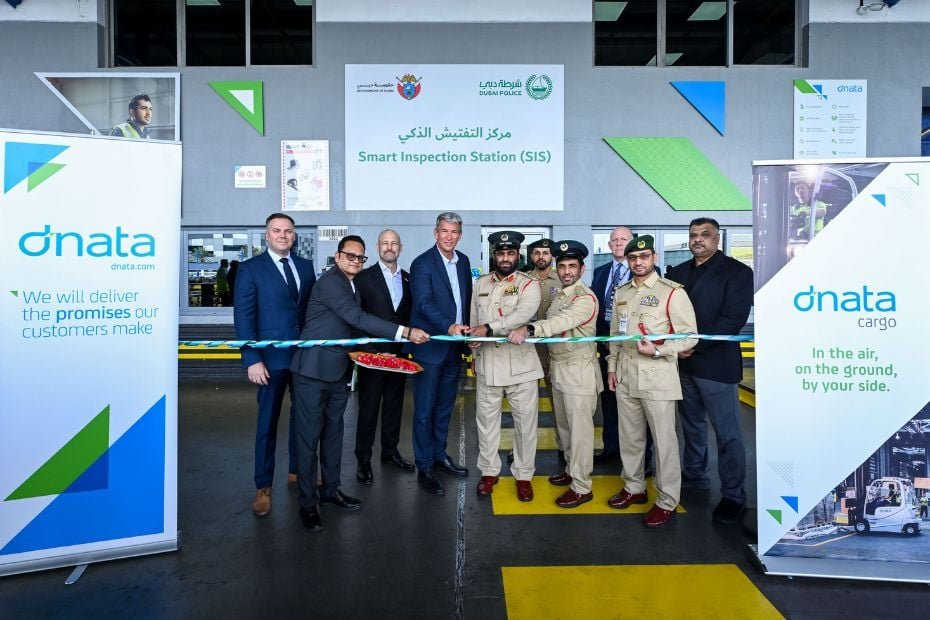

Image credit: WAM/Website
dnata, a leading global air and travel services provider, has launched a new centralised screening control room at its Dubai International Airport (DXB) cargo facility, developed in partnership with Dubai Police. The initiative represents a major leap in the digital transformation of air cargo operations, combining real-time automation with enhanced security oversight, a WAM report said.
Read more-Dubai’s winter travel surge: New Routes, schedules that passengers must know about
From a single high-tech command centre, Dubai Police officers can now remotely operate and monitor six X-ray screening machines across dnata’s warehouse. Each device integrates with One Cargo, dnata’s digital cargo management system, automating key business and operational functions. The platform enables instant data sharing, streamlined workflows, and faster decision-making.
“Through close collaboration with Dubai Police, we’ve introduced a model that strengthens security, boosts efficiency, and reflects Dubai’s commitment to innovation,” said Guillaume Crozier, dnata’s chief cargo officer.
Centralisation drives efficiency
Previously, cargo screening occurred across multiple warehouse locations, leading to higher resource use and reduced efficiency. The new centralised approach consolidates processes into a single hub, reducing screening time and improving throughput by around 3 per cent annually.
dnata, which serves more than 120 airline customers, manages an average of 60,000 tonnes of cargo each month at DXB. Earlier this year, the company processed over 1 million tonnes of cargo between April 2024 and March 2025, the highest annual volume across its DXB and DWC operations, representing roughly 30 per cent year-on-year growth.
Automation and analytics reduce costs and carbon footprint
The system minimises manual touch points, enables advanced analytics, and optimises resource use, cutting unnecessary cargo movement and reducing fuel consumption inside the facility. The control room was jointly designed by dnata and Dubai Police to handle both primary and secondary command functions. It features advanced monitoring interfaces, live imaging, and automated reporting tools, ensuring traceability at every stage of the screening process.
“Dubai’s success as a global hub comes from a shared commitment between public and private partners,” added Crozier. “This collaboration with Dubai Police reflects that spirit, leveraging technology and trust to create a strong cargo ecosystem that keeps the city’s trade moving efficiently.”
Looking ahead: robotics and smart cargo solutions
The control room is part of dnata’s broader initiative to reimagine cargo operations through data, automation, and design thinking. Across its Dubai facilities, the company is exploring autonomous mobile robots (AMRs) to move shipments safely and efficiently across warehouse floors, reducing forklift traffic and improving space utilisation.
Additionally, dnata is testing automated dimensioning and load-optimisation tools that capture the exact size and weight of shipments. This technology maximises space inside Unit Load Devices (ULDs), cuts waste, and allows for precise, data-driven cargo flows.
“Behind every piece of technology we adopt are the people who make it work,” Crozier said. “Our teams on the ground are the driving force behind this transformation, using new tools to move cargo more securely and intelligently than ever before.”
