

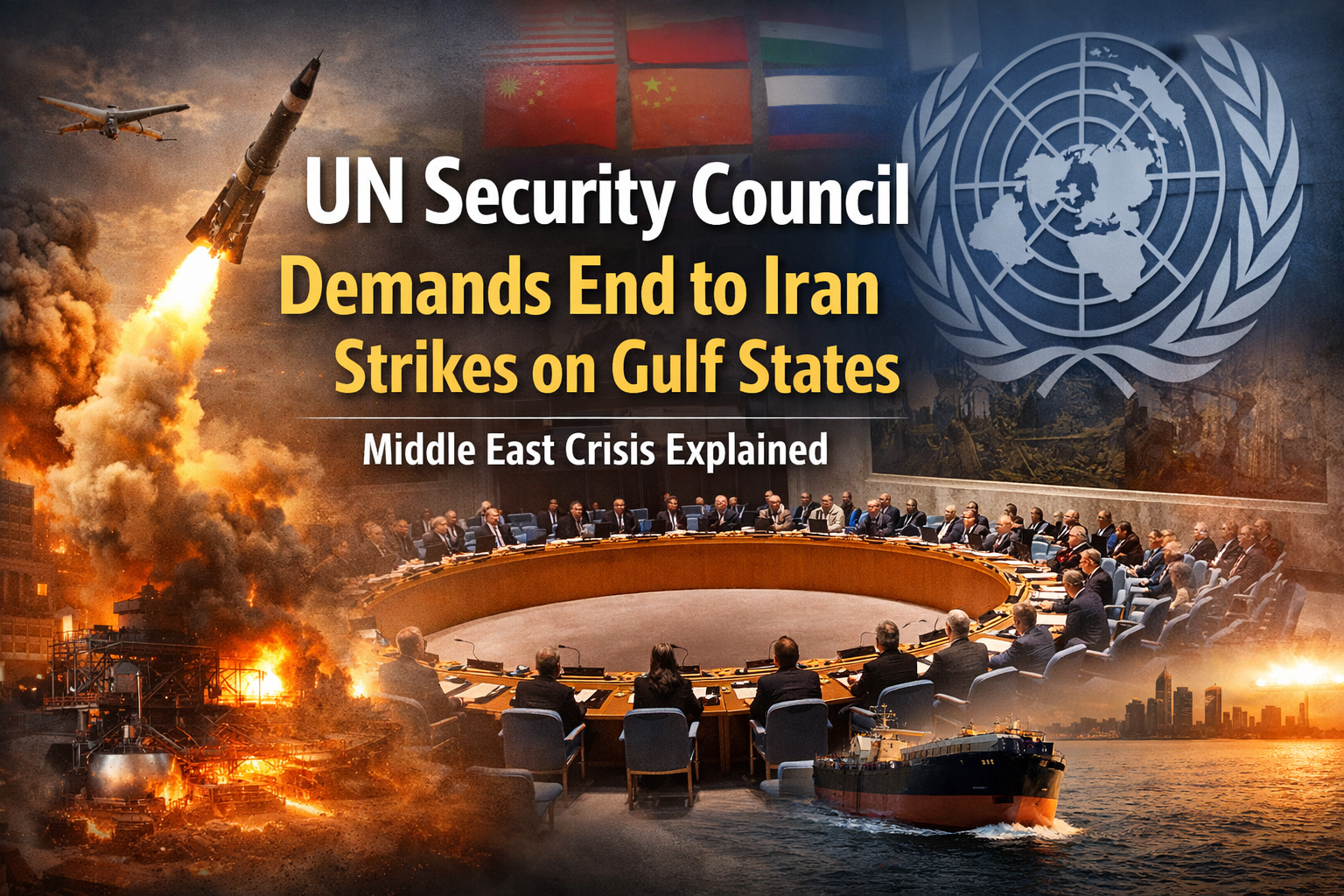
The United Nations Security Council recently adopted a resolution demanding that Iran immediately stop its missile and drone strikes on Gulf states. The decision comes amid rising tensions and growing conflict across the Middle East. The resolution highlights international concern about regional security, global oil supply, and the safety of international shipping routes.
This development marks an important moment in global diplomacy, as the international community attempts to prevent a wider war in the Gulf region.
Background of the Middle East Conflict
The Middle East has long been a region of geopolitical tension. Over the past few months, conflicts involving Iran, Israel, and several Gulf countries have intensified. Missile attacks, drone strikes, and military operations have raised fears of a larger regional war.
Iran has been accused of launching attacks targeting multiple Gulf states, including Saudi Arabia, the United Arab Emirates, Bahrain, Kuwait, Oman, Qatar, and Jordan. These strikes have included missiles and drones aimed at infrastructure and shipping routes in the Gulf region.
The situation escalated further when attacks began threatening key maritime routes such as the Strait of Hormuz, one of the world’s most important oil shipping lanes.
Because of these developments, the United Nations Security Council held an emergency meeting to address the crisis.
UN Security Council Resolution
During the meeting, the Security Council adopted a resolution condemning Iran’s actions and demanding an immediate halt to all attacks on Gulf countries.
The resolution was adopted with strong support from most members of the council.
- 13 countries voted in favor
- 2 countries abstained (Russia and China)
- No country voted against the resolution
The resolution was sponsored by Bahrain and supported by the Gulf Cooperation Council (GCC).
The resolution calls on Iran to stop:
- Missile attacks on Gulf countries
- Drone strikes targeting infrastructure
- Any interference with international shipping
- Threats to maritime security in the Strait of Hormuz
The United Nations emphasized that such attacks threaten international peace and stability.
Why the Resolution Matters
The resolution is important because it represents a united response by the international community against escalating violence in the Middle East.
Several key issues are at stake:
1. Regional Stability
The Gulf region is strategically important. Any large-scale conflict could spread across multiple countries and create a major security crisis.
The UN hopes that diplomatic pressure will prevent further escalation.
2. Global Oil Supply
The Gulf region produces a large portion of the world’s oil. The Strait of Hormuz alone handles a significant percentage of global oil shipments.
If conflict disrupts this route, it could cause:
- Rising oil prices
- Global economic instability
- Energy shortages
Iran has already warned that oil shipments could be blocked if the conflict continues.
3. International Shipping
Many global trade routes pass through the Gulf region. Attacks on ships or ports could disrupt international commerce.
The resolution therefore stresses the importance of protecting freedom of navigation.
Iran’s Response to the Resolution
Iran strongly criticized the UN Security Council’s decision.
Iran’s ambassador to the United Nations described the resolution as politically motivated and unfair.
According to Iranian officials, the resolution ignores airstrikes carried out by the United States and Israel against Iranian targets.
Iran argued that the resolution focuses only on Iranian actions without addressing the broader conflict.
Iran also claimed that it has the right to defend itself against foreign military attacks.
Because of this disagreement, tensions between Iran and Western countries remain high.
Role of Major Global Powers
The vote in the Security Council revealed divisions among major world powers.
United States and Western Allies
The United States supported the resolution and stated that Iran’s attacks threaten regional security.
American officials said the vote shows global opposition to Iran’s strategy of attacking neighboring countries.
Several European countries also supported the resolution.
Russia and China
Russia and China did not vote against the resolution but chose to abstain.
Both countries argued that the resolution did not mention attacks against Iran by other countries.
They called for a balanced approach that addresses all sides of the conflict.
This reflects the broader geopolitical rivalry among global powers.
Impact on Gulf Countries
The Gulf states have welcomed the UN resolution.
Countries such as Saudi Arabia and the United Arab Emirates have faced repeated drone and missile threats targeting:
- Oil facilities
- Airports
- Shipping ports
- Energy infrastructure
Several Gulf countries have intercepted drones and missiles aimed at critical oil installations.
The resolution gives these countries international diplomatic support and recognition of their security concerns.
It also sends a strong message that attacks against sovereign states are unacceptable.
Economic and Energy Implications
The conflict has already begun affecting global energy markets.
If the situation worsens, the consequences could include:
Rising Oil Prices
Oil prices are closely linked to stability in the Middle East. Any disruption in the Gulf region can cause sudden price increases.
Analysts warn that continued conflict could push oil prices significantly higher.
Supply Chain Disruptions
Shipping companies may avoid the region if security risks increase. This could slow global trade and increase transportation costs.
Investor Uncertainty
Political instability often creates uncertainty in global markets.
Investors may become cautious about investments in the Middle East until the situation stabilizes.
Diplomatic Efforts to Prevent War
The United Nations and several international leaders are now pushing for diplomatic negotiations.
The UN Secretary-General has urged all parties to avoid further escalation and return to peaceful dialogue.
Diplomatic efforts include:
- Emergency meetings between world leaders
- Negotiations involving regional powers
- Calls for ceasefires and de-escalation
The goal is to prevent the situation from turning into a full-scale regional war.
Possible Future Scenarios
The situation in the Gulf region could develop in several ways.
Scenario 1: Diplomatic Resolution
Iran and Gulf states could agree to negotiations, reducing tensions and preventing further conflict.
Scenario 2: Continued Limited Conflict
Missile and drone strikes could continue without escalating into full war.
Scenario 3: Regional War
If tensions continue to rise, multiple countries could become involved in a larger military conflict.
This is the scenario the international community hopes to avoid.
Importance of the Strait of Hormuz
One of the most critical aspects of the crisis is the Strait of Hormuz.
This narrow waterway connects the Persian Gulf to the global ocean and is used for transporting oil and gas.
Any disruption here could affect the entire global economy.
Because of its importance, the UN resolution specifically warns against blocking or interfering with navigation in the strait.
Protecting this shipping route is a major priority for many countries.
Conclusion
The United Nations Security Council’s resolution demanding an end to Iran’s strikes on Gulf states highlights the seriousness of the current Middle East crisis.
The international community is concerned about regional stability, global energy supplies, and the risk of a broader war.
While the resolution sends a strong diplomatic message, the future of the conflict will depend on whether all parties choose negotiation over escalation.
The coming weeks will be critical in determining whether the region moves toward peace or further instability.
FAQs
1. Why did the UN Security Council pass a resolution against Iran?
The UN Security Council passed the resolution because Iran was accused of launching missile and drone attacks against several Gulf countries. The resolution demands that Iran stop these attacks immediately.
2. Which countries supported the resolution?
Thirteen members of the Security Council voted in favor of the resolution, while Russia and China abstained from the vote.
3. Which Gulf countries were targeted by Iran?
The attacks reportedly targeted Bahrain, Kuwait, Oman, Qatar, Saudi Arabia, the United Arab Emirates, and Jordan.
4. Why is the Strait of Hormuz important?
The Strait of Hormuz is one of the world’s most important oil shipping routes. A large portion of global oil supply passes through it.
5. What could happen next in the conflict?
Possible outcomes include diplomatic negotiations, continued limited conflict, or escalation into a larger regional war.
