

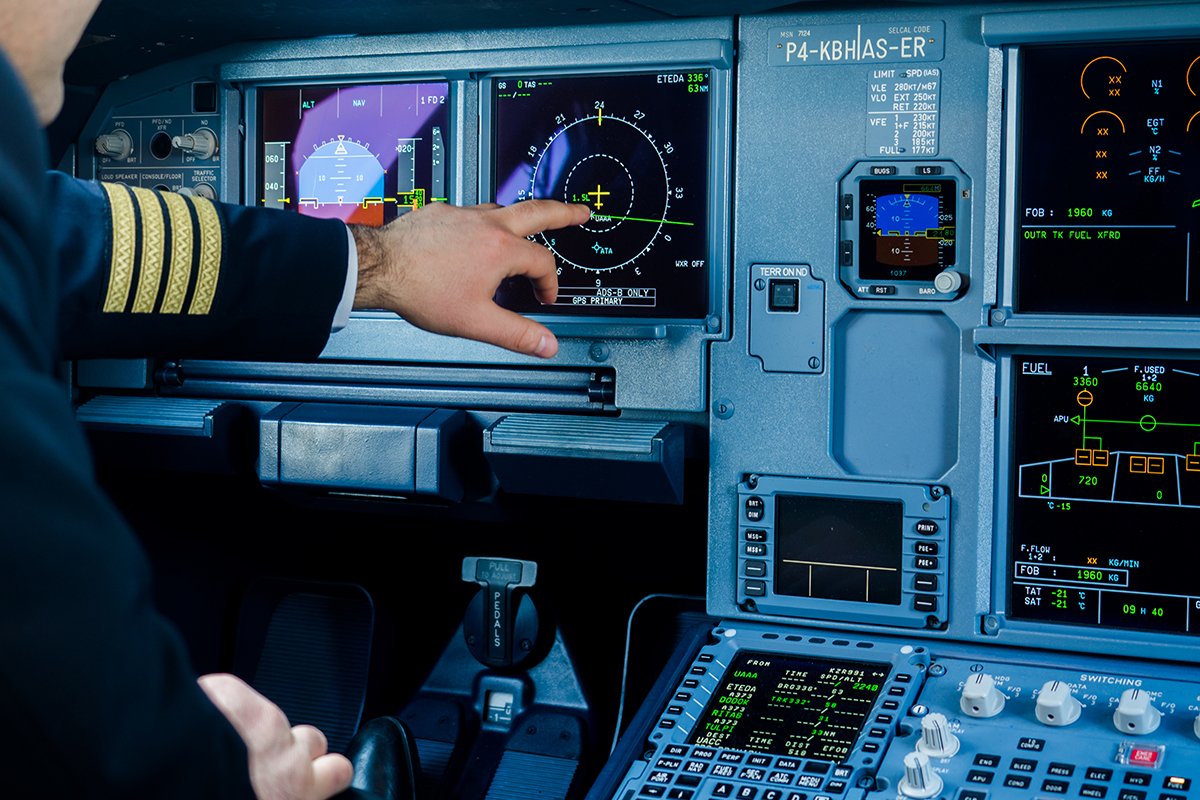
Industry reports show a 500 per cent increase in GPS spoofing incidents in 2024, with approximately 1,500 flights affected daily by mid-year, compared to just 300 per day in early 2024, according to Ivan Pisarev, Regional Technical Lead – META at Group-IB. In the one-month period from July 15 to August 15, 2024 alone, approximately 41,000 flights experienced spoofing incidents.
“What was once a rare technical issue is now becoming increasingly critical, and it is already impacting not only the aviation sector but also everyday users,” Pisarev told Arabian Business.
Recent incidents have included ships appearing in incorrect locations, commercial flights losing satellite signals mid-air, and even mobile phone clocks displaying wrong times — events that have been noticed in the UAE and globally, experts said. A notable maritime incident in mid-June 2025 near the Strait of Hormuz contributed to a collision when GPS interference affected navigation systems.
Beyond navigation
While most consumers associate GPS with navigation apps, its role extends far beyond directions to the nearest café.
“GPS is not just about where you are, it’s about when you are, too,” explained Luca Ferrara, General Manager at AQNav, SandboxAQ. “Banks depend on it to time-stamp financial transactions. Data centres use it to keep their databases aligned. Telecom networks use it to manage traffic.”
Pisarev added that GPS “quietly becomes a backbone technology for everything from aviation and agriculture to mobile networks and financial markets.”
The European Agency for the Space Programme projects annual shipments of Global Navigation Satellite System (GNSS) receivers to grow from 1.8 billion units to 2.5 billion units by 2031, underscoring the expanding reliance on this technology.
Rising threats
GPS signals are inherently vulnerable due to their public nature, experts said.
“Jamming is a growing concern, and it’s relatively easy to do,” Ferrara noted. “You can think of it like noise-cancelling headphones. By broadcasting signals that ‘cancel out’ GPS, even a small, low-power device, the size of a walkie-talkie can disrupt receivers.”
More concerning is spoofing, where devices mimic authentic GPS signals to trick receivers into reporting false locations.
The surge in attacks began notably in September 2023, with civil aviation spoofing increasing dramatically. Overall, 2024 saw a 62 per cent jump in GPS disruptions over conflict zones compared to 2023 — 430,000 incidents versus 260,000 the previous year.

The Gulf region faces particular challenges due to its geopolitical significance and role as a global air travel hub.
“Due to geopolitical reasons, we might expect GPS jamming and spoofing to be prevalent on a daily basis for defensive reasons alone,” Ferrara said. “It is also possible that intentional spoofing could be occurring to create disinformation which increases the fog of war so to speak.”
Regional data shows approximately 200 flights per day are currently impacted by spoofing over the Gulf and Israel. In other hotspots, such as the Baltic Sea, a single jamming incident on March 23-24, 2024, affected over 1,600 aircraft.
‘Single point of failure’
The widespread dependence on GPS has created what experts describe as a “single point of failure” in global infrastructure.
“The consequences vary — from relatively minor issues like rideshare delays to far more serious risks,” Pisarev said. “Emergency responders may lose critical location data. Self-driving systems can go off-route. Delivery networks can stall.”
Current fallback systems are often outdated and inefficient. In aviation, for example, pilots must revert to communication with control towers and inertial navigation systems that lose accuracy over time.
“If an aircraft were to have its GPS disrupted, then typically, the pilot has to radio the nearest control tower, where operators would use radar to pinpoint the plane’s position and keep them on course,” Ferrara explained. “But these towers are already busy, and you can imagine how quickly that system would be overwhelmed if dozens or hundreds of aircraft lost GPS at once.”
Pilots have reported false terrain warnings and various systems malfunctioning, including Enhanced Ground Proximity Warning Systems (EGPWS), flight management systems, and automatic dependent surveillance-broadcast (ADS-B).
Next-generation solutions
Industry and governments are developing alternative navigation technologies to address these vulnerabilities.
One approach involves using multiple GNSS systems simultaneously — combining GPS with signals from Galileo, GLONASS, and BeiDou to increase resistance to spoofing.
“One key shift is toward multi-GNSS — devices that use not just GPS, but also signals from Galileo, GLONASS, and BeiDou. This dramatically increases resistance to spoofing, since disrupting four systems simultaneously is far more complex,” said Pisarev.
Regulatory bodies are also taking action. The European Union plans to enhance Galileo authentication and encryption systems, with improvements expected to be ready by 2026. Meanwhile, the International Air Transport Association (IATA), the European Union Aviation Safety Agency (EASA), and various national aviation authorities have issued guidance bulletins on handling GPS disruptions.

More innovative solutions are also emerging. SandboxAQ has developed a system called AQNav that uses Earth’s magnetic field for navigation, similar to how birds and whales navigate naturally.
“We’ve applied the same principle to create highly detailed magnetic maps of the Earth, which our systems can use for positioning even if GPS is down,” Ferrara said. “This technology… is already being tested with the US Air Force, Airbus, and Boeing, and showing strong promise.”
The UK has made significant progress with quantum navigation, conducting a trial in May 2024 at MoD Boscombe Down in Wiltshire, where an Avro RJ100 aircraft was equipped with quantum navigation equipment that used ultracold atoms to power quantum accelerometers and gyroscopes.
“The UK has already committed to deploying quantum navigation systems on all their commercial aircraft by 2030. This technology could become the future of aeronautical navigation,” Pisarev noted.
The path forward?
Experts emphasised that addressing GPS vulnerabilities requires a multi-faceted approach.
“It is important to understand that active measures to counter this problem are already being taken, both in terms of improving technical solutions and in data sharing,” Pisarev said. “It is impossible to overcome such a complex issue with a single method — what is needed is the right architecture.”
His recommended framework includes: more signals than interference, smarter receivers, systems that don’t lose time, and visibility of attacks through monitoring and common reporting standards.
Ferrara stressed the need for faster implementation of new technologies. “While many committees and reports have been written of late, there needs to be more concerted efforts to introduce new technologies, processes, and procedures into the operations of airlines, shippers, and logistics companies to improve resiliency to GPS outages.”
As autonomous systems become more prevalent in global economies, experts believe the urgency of addressing GPS vulnerabilities will only increase.
“As we seek to increase autonomy in our economies, the issue of GPS reliance will only become more acute,” Ferrara said.
“It is incumbent on us to fortify and diversify how systems position themselves, get time, and navigate, so they are ultimately less reliant on a single piece of what has been a truly revolutionary technology in GPS.”
