

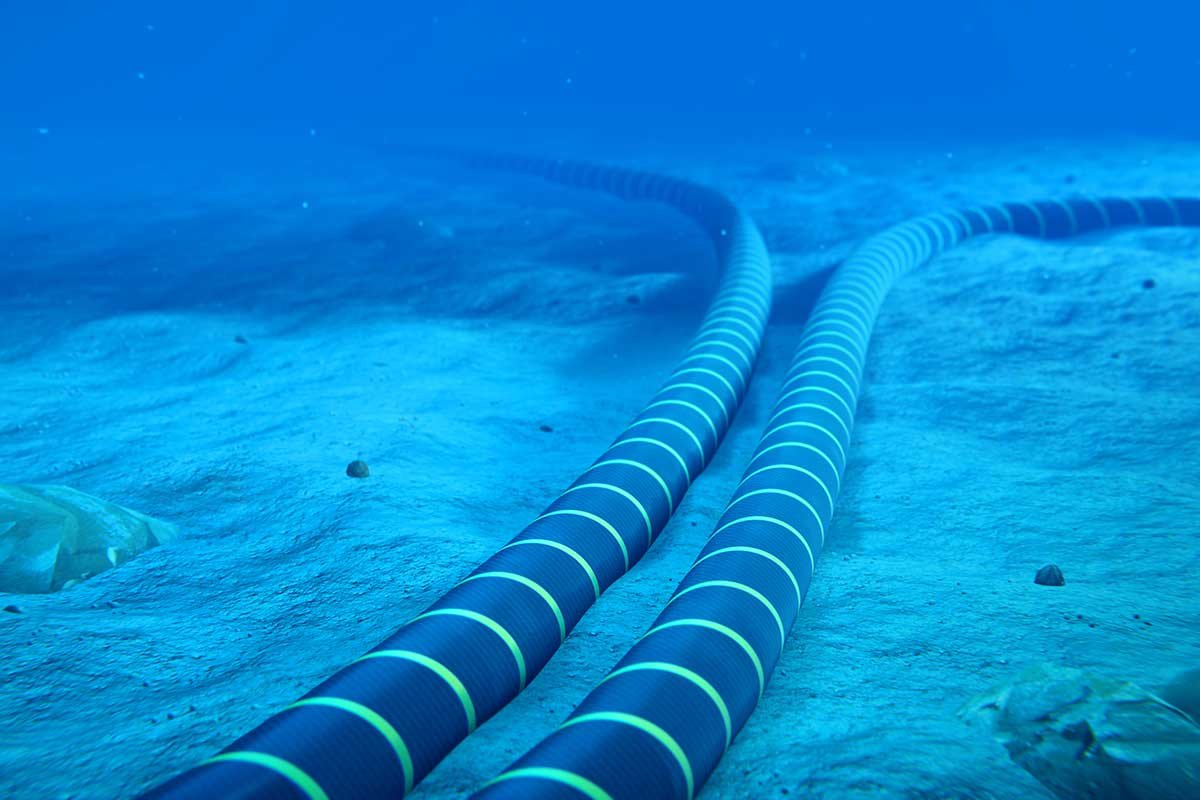
Subsea cables carry over 99 per cent of the world’s internet traffic, forming the invisible backbone of everything from streaming video and financial transactions to cloud workloads and military communications. But as generative AI models and hyperscale data centres drive exponential growth in demand, legacy systems are showing signs of saturation — particularly across well-established routes like the North Atlantic.
“AI workloads are placing immense pressure on global data infrastructure,” Carl Grivner, CEO of FLAG, one of the world’s largest privately owned subsea cable operators, told Arabian Business. “The current systems just can’t keep up, and that’s creating an urgent need for high-capacity, low-latency subsea networks.”
FLAG, formerly Global Cloud Xchange, operates a global cable system spanning Asia, the Middle East, Europe and the United States. The company says it is actively targeting new cable corridors across underserved and high-growth regions, including Southeast Asia, the Pacific and the Middle East, where it sees long-term strategic opportunity.
“We’re looking at new corridors — places like the Transpacific — which are critical for the next wave of growth,” Grivner said. “We focus on markets that are growing with the need for digital infrastructure. If we get this right, we don’t just meet technical demand but also ensure equitable connectivity, so that all people have reliable access to the internet.”
Hyperscaler disruption
The rise of hyperscaler technology firms like Google, Meta, Amazon, and Microsoft is reshaping the architecture of subsea connectivity. Rather than joining traditional telecom-led consortiums, many of these companies are now building and owning their own cables, creating private, purpose-built systems tailored to their cloud and AI infrastructure needs.
Google has led the charge, followed by Meta, which continues to back consortium-based builds, while Amazon and Microsoft pursue targeted investments in specific geographies. While these moves are redrawing the global data map, they also risk reinforcing bandwidth inequalities.
“Hyperscalers are moving fast,” Grivner said. “It’s a challenge to keep up, but we adapt by being agile, forming strategic partnerships and navigating complex regulatory environments, particularly in economies with large wealth gaps where the digital divide presents the greatest growth potential.”
While hyperscalers dominate transoceanic traffic across mature routes, FLAG is positioning itself as a complementary player in emerging corridors. The company recently secured $340 million in refinancing to support the buildout of new cable landing stations, edge data centres and bespoke connectivity solutions aimed at enterprise and carrier clients.
Middle East as a rising digital hub
One area of particular focus for FLAG is the Middle East, where national governments and sovereign wealth funds are investing heavily in digital infrastructure. FLAG has deployed new regional routes — including its Gulf-European Transit and Saudi Transit paths — to strengthen connections between the GCC and Europe.
“Our presence in the Middle East is unmatched, powered by our FALCON system, which boasts over 20 landing points throughout the region — including direct connections in every GCC country,” Grivner said.
The Gulf’s growing role as a digital crossroads is accelerating, as countries like Saudi Arabia and the UAE seek to localise data, develop cloud regions, and enhance digital sovereignty. While FLAG did not name specific sovereign partners, it confirmed that new deployments in the region are active and ongoing.
The Middle East’s transformation into a global data hub mirrors wider shifts in subsea investment priorities. According to industry estimates, the global subsea cable market is projected to reach $30.9 billion in 2025 and grow to $56.9 billion by 2035. Yet this boom brings with it new challenges, including geopolitical risk, climate exposure and ageing maintenance fleets.
Fragile infrastructure
Despite their critical role, subsea cables remain surprisingly vulnerable. Around 200 faults occur globally each year, mostly due to accidental damage by fishing vessels and ships’ anchors. Meanwhile, a recent industry report warned of a $3 billion shortfall in investment for cable repair ships, many of which are now decades old and stretched beyond capacity.
Grivner argues that the industry must move beyond simply adding more cables. Instead, it needs to embrace system-level integration by bringing together subsea networks, edge computing, and smart routing platforms to ensure more resilient, intelligent infrastructure.
“The real opportunity is integration and convergence,” he said. “Subsea cables, edge data centres, and intelligent platforms need to work together. That’s how we move data faster and smarter.”
In many regions, particularly across parts of Africa, South Asia and the Pacific Islands, infrastructure remains highly fragmented, making it difficult to meet the growing demand for AI, IoT and cloud services. Grivner believes the private sector has a role to play in closing these gaps.
“The world doesn’t just need more bandwidth,” he said. “It needs smarter, integrated systems that turn raw connectivity into scalable platforms for innovation.”
FLAG’s growth strategy is firmly tied to the evolution of global data flows, which are increasingly shaped by AI models, decentralised applications and real-time analytics. As cloud providers continue to localise operations, demand is growing for high-availability, low-latency routes that bypass congested hubs.
“Our infrastructure is designed to support the next wave of AI, cloud and IoT technologies — not just in major hubs, but in the places that have been defined as future cloud regions,” Grivner said.
With its focus on network diversity and geographic flexibility, FLAG says it is building a system designed for both resilience and reach, particularly in areas that have historically been neglected by global investment.
“We’re focused on the places that could be deemed hard to navigate,” Grivner said. “We firmly believe that universal connectivity is not just a technological goal, but a fundamental human right — and essential to facilitating global trade and prosperity.”
