

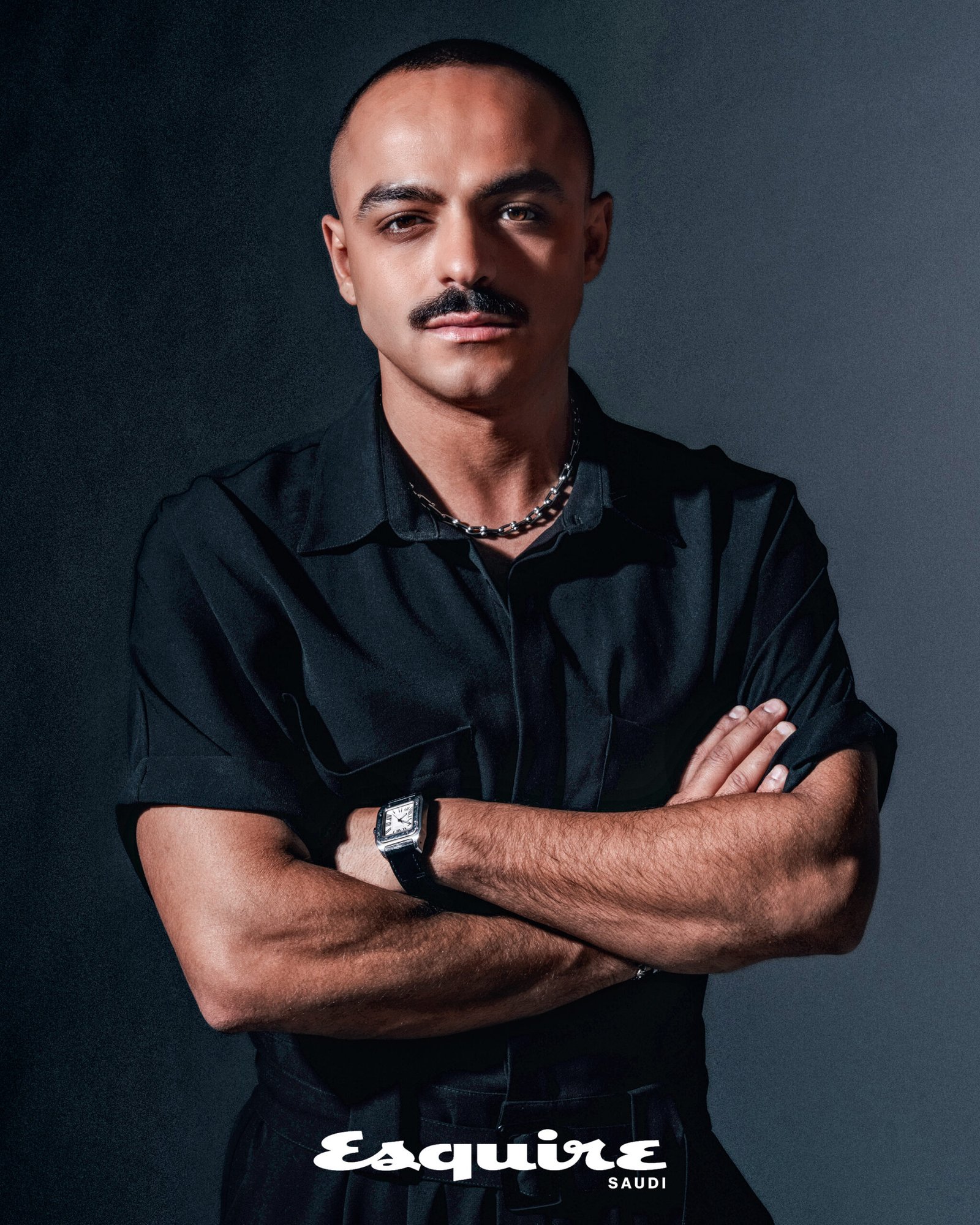
The launch of Riyadh Fashion Week in 2023 marked a turning point in the Saudi fashion scene, and this momentum has created fertile ground for designers to break free from convention and introduce a new vision in the Kingdom.
Among those leading this shift is Turki Alassaf, creative director of USCITA, the Kingdom’s first gender-fluid brand. The name comes from the Italian “exit” embodying the principle of shedding tradition in favour of individuality and progress, in a country where social and cultural changes are happening at a fast pace.
Co-founded with Faisal Almujyish, USCITA embraces minimalist luxury, simplicity and authenticity. For Alassaf, it is a way forward for a society navigating rapid cultural shifts. His own story mirrors this ethos. Born in Riyadh as the eldest of five, he came of age as the city was still finding its rhythm. In his teens, he discovered the phrase that would guide him: ‘Sii Te Stesso’ (Italian for “Be yourself”). From then, his mission was clear: to help others embrace individuality without fear. “Fashion became my way of telling people: don’t hide, don’t apologise, just be yourself,” he says.


USCITA’s collections reflect this mantra. Rooted in simple luxury, they act as a dialogue between cultural norms and personal expression. The label works with premium materials such as silk and cotton, alongside artisanal techniques that give each piece individuality. “When you put it on, it should feel made for you. That is why craftsmanship matters; it turns clothing into something timeless,” says Turki Alassaf.
Already worn by English actor Ed Westwick and Kuwaiti actor Mahmoud Boushahri, the garments, often ethereal and symbolic, use muted tones, clean cuts, and subtle details to convey meaning beyond their labels.
In a region where fashion is often tied to extravagance, Alassaf chose a quieter, more deliberate path. “Each piece should tell its own story without unnecessary embellishments,” he says. The result is timeless clothing: loose-fit shirts that shift from day to night, vests that move seamlessly from office to evening, and jackets that whisper elegance instead of demanding attention.

And the city of Riyadh itself shapes this vision. “The city changes every day,” Turki Alassaf reflects. “You walk outside and suddenly there is a new building, a new café, a new cultural space. I wanted USCITA to reflect this energy. That balance between heritage and progress runs through every stitch.”
But USCITA is more than a label; it is a community. Alassaf describes its wearer as someone who loves more, fears less, embraces change and mixes codes of dress without hesitation. They are environmentally conscious, socially aware, confident yet humble. “USCITA is for people with high self-esteem and low ego,” he says. “For those confident enough to be different and kind enough to support others.”
Perhaps the most understated yet radical aspect of USCITA is its embrace of gender-fluid design. Amid a culture of tightly coded clothing, Alassaf brings a more progressive approach. “Cuts are not gender-limited,” he insists. “The language of fashion is universal; you just need to wear it with confidence. I do not want to create controversy; I want to normalise. I want people to feel comfortable wearing these designs not only abroad, but here in Riyadh.”
Colour is central to this normalisation. Alassaf rejects the notion that hues belong to genders. “Colours do not define masculinity or femininity,” he says. “Purple, pink, orange…these are for everyone. Arab men have always worn colour, especially in the past. It faded for a while, but now it is coming back, and that makes me happy.”

Looking ahead, the designer envisions USCITA as a globally recognised force in gender-fluid fashion, celebrated for inclusivity, craftsmanship and narrative power. Expansion into international markets is on the horizon, alongside sustainable practices aligned with its community’s values. “The brand is just at the beginning,” he adds.
This vision reflects broader developments across the country, where strategic investments are helping to turn ambitions into reality. Saudi Arabia’s growing commitment to fashion is evident in moves like the Public Investment Fund’s acquisition of a 40 percent stake in the Selfridges Group.
Once unimaginable, it is safe to say this is a new era, with Saudi designers stepping onto global platforms.
