

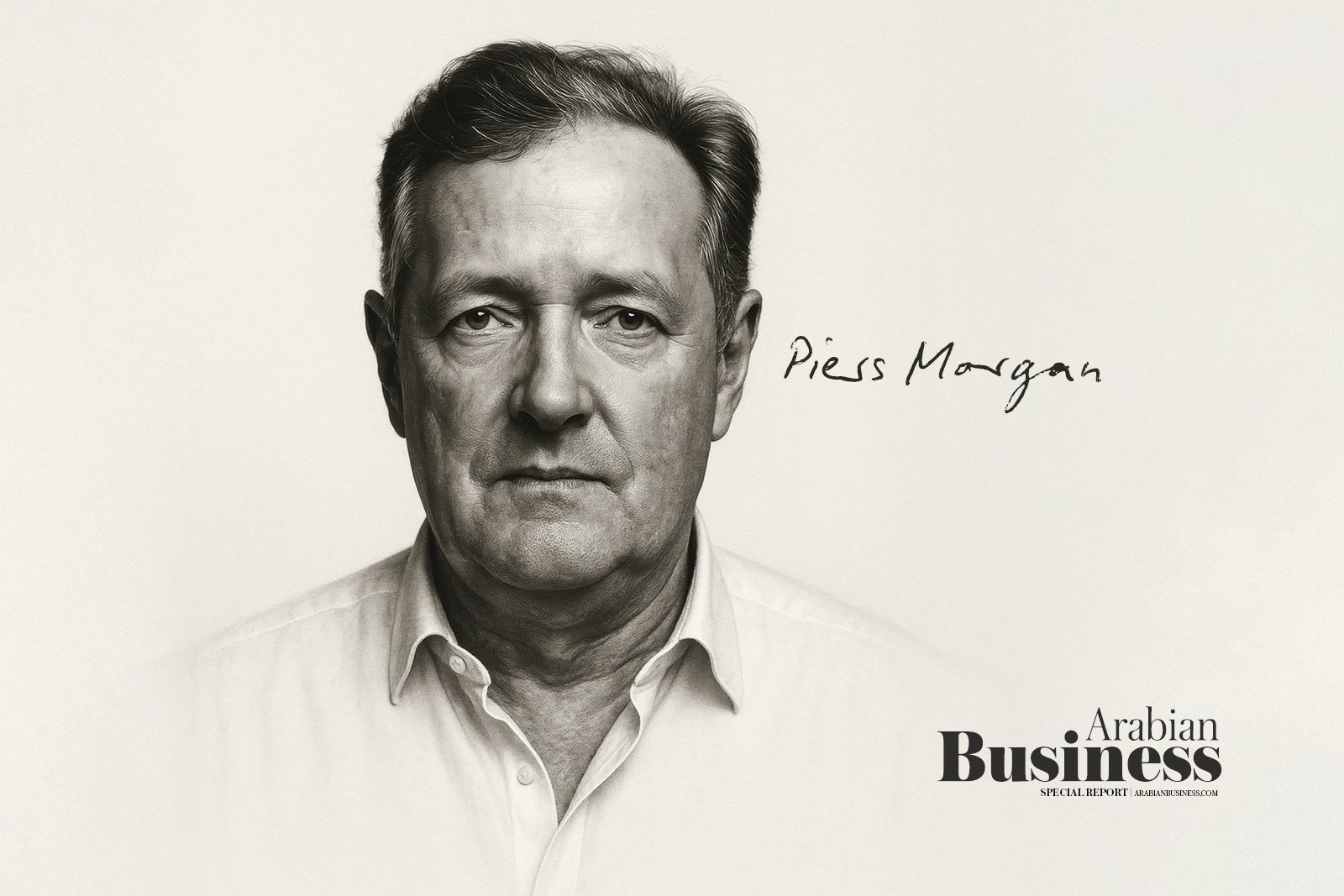
For a man long associated with Western media orthodoxy, Morgan’s recent commentary on Israel’s military campaign has marked a significant pivot. Though he never explicitly said “I changed my mind,” the message was clear throughout – the facts have changed, and so has he. “What they’re doing now is unjustified, unacceptable, probably illegal – and it needs to stop,” he says of the Israeli military campaign.
This statement represents a marked departure for a media figure whose initial reaction to Hamas’ October attack reflected the narrative of Israel’s “right to defend itself.” That shift, from supportive understanding to public criticism, mirrors a broader transformation taking place across Western capitals, newsrooms, and public opinion.
Morgan’s recent visit to Dubai for the Arab Media Forum, his first since documenting the emirate for ITV just before the 2008 financial crash, left him visibly impressed with the region’s transformation. “To be back there after so long and to see just how much has been done since I was there was staggering,” he says with genuine enthusiasm. “The rate of growth… There’s just a real dynamism about the whole Middle East now, which is very infectious with a real can-do mentality, a lot of optimism, a lot of drive, a lot of creative energy.”
A collective awakening
Morgan’s evolution is neither sudden nor isolated. It reflects a gathering momentum steadily challenging the initial consensus that emerged after October 7th. His platform, which reaches millions through social media, serves as both barometer and catalyst for this changing perception.
“It’s not just people like me,” Morgan states. “It’s also leaders of some of Israel’s biggest allies – the UK, France, Germany – even former Israeli Prime Ministers now coming out accusing the Israeli government of committing war crimes. This is very serious.”
The stark statistics underpinning this shift are grim – over 50,000 Palestinians killed, according to the UN Office for the Coordination of Humanitarian Affairs, alongside extensive destruction of civilian infrastructure and a humanitarian crisis of historic proportions. These facts have begun to erode what was once near-unanimous Western support for Israel’s military response.
Morgan identifies early 2024 as his personal turning point. “I just started getting more and more exercised about what I saw as a failure by the Israeli government to achieve its objective,” he explains. The continued captivity of hostages, mounting civilian casualties, and what Morgan describes as “no endgame to this war” began to fundamentally alter his assessment.
The humanitarian blockade imposed on Gaza particularly crystallised his concerns. “It seemed to be a deliberate, appalling, systematic attempt to starve the Palestinian people. And I don’t think you can dress it up as anything else,” he states.
What emerges is not a narrative of sudden conversion but a gradual reckoning with accumulating evidence – a process playing out across editorial boards, diplomatic circles, and public discourse throughout the Western world.
The information battlefield
At a time when information warfare often supersedes physical combat in shaping public perception, Morgan has positioned his platform as a rare space for genuinely adversarial debate on Gaza. His interviews – from Bassem Youssef’s viral appearance to confrontations with Israeli officials – have provided a platform where competing narratives can be directly challenged.
This approach places him at the heart of an increasingly polarised media landscape. “Social media has become very toxic, very tribal,” Morgan observes. “People don’t want to hear other views. They don’t want to hear any facts that may go against their side.”
When asked how he handles the barrage of criticism from all sides, Morgan’s response is characteristically defiant. “I’ve got the skin of a thousand rhinoceros,” he declares. “Don’t worry about me. It’s all just water off a duck’s back. I don’t care. It’s actually very revealing about the people doing it, because a lot of them were praising me, of course, when I was being supportive of Israel’s right to defend itself.”
Perhaps most significantly, Morgan has made Israel’s restrictions on international journalists a central focus of his criticism. “Let the journalists in. If you’ve got nothing to hide, let them in,” he says – a statement that reads less like a mere media remark than a challenge to power, a rallying cry for press freedom.
This blockade on independent verification has become, in Morgan’s view, not just a professional frustration but a central moral issue in the conflict. “If they don’t allow the journalists on the ground, they can just basically pull down on everything,” he explains.
Beyond self-defence
The language Morgan now uses to describe Israel’s military campaign marks perhaps the most striking evidence of his shift. Terms like “collective punishment” and references to possible “genocide” have entered his commentary.
“Some of the people in that government absolutely are, in their heads, waging a form of genocide – and that is a crime,” Morgan states unequivocally. This marks a stark contrast with his earlier resistance to such framing, including a 2024 interview with Candace Owens where he said, “I take issue with people who want to frame it as genocide.”
Morgan points specifically to recent statements by Israeli government officials, notably Finance Minister Bezalel Smotrich’s declaration that the mission was no longer about self-defence but about removing all Palestinians from Gaza. “Whatever way you want to dress it up – it’s genocide.”
His willingness to revise his views based on evidence embodies a journalistic ethos that is increasingly rare in conflict coverage – one that has made him a target from all sides of the polarised discourse.
Trump, Gaza, and realpolitik
The geopolitical calculus around Gaza has rarely been more unpredictable. But one figure looms large in Morgan’s analysis: Donald Trump. Their long and complex relationship offers Morgan a rare vantage point – one blending familiarity with strategic distance.
In his view, Trump is less a symbol of ideology than a lever of consequence – perhaps the only leader with the political muscle, and maybe the ego, to shift the stalemate.
“Trump’s the only one who has the muscle to pull the plug on Netanyahu – and he should,” Morgan tells Arabian Business.
He envisages a scenario where Trump uses America’s influence over Israel to force a resolution. “I think he should say, you’ve got to get back to a ceasefire, you’ve got to get back to negotiating the release of the hostages.”
“Having known Trump a long time, I detect his patience is wearing thin with Netanyahu and the way he has fired back up this war from a ceasefire to a starvation blockade, relentless bombardment, endless civilian deaths.”
Beyond tribalism
Throughout the interview, Morgan rejects the binary framing that has long dominated discourse on the conflict. “I don’t want people to think I’ve switched sides,” he insists, “because that would imply I was on somebody’s side to start with – and I wasn’t.”
This position – critical of both Hamas and the Netanyahu government while expressing concern for civilian populations – represents a nuanced stance, increasingly difficult to maintain in public debate.
“I believe Palestinians should have absolutely the same human rights as you do, as I do, as Israelis do,” he says, framing the conflict fundamentally as a matter of universal rights.
Morgan draws parallels to Northern Ireland’s peace process and suggests that a resolution requires “completely fresh leadership.” “You need Hamas gone, you need Netanyahu gone. You need a new leadership in Israel, new leadership for the Palestinians, new direction from the United States and the concerted help of neighbouring Arab countries.”
Looking beyond the immediate conflict, Morgan sees a wasted opportunity for regional cooperation. “I was also in favour of the Abraham Accords,” he notes thoughtfully. “And I know that many people in Saudi Arabia, for example, would love to get to a place of normalising relations with Israel, but obviously cannot do so as long as this war in Gaza is raging. Just on that practical level of trying to move the region to a more peaceful place where people can work together for mutual benefit, that cannot happen while this war is raging.”
The weight of witness
What stands out most in Morgan’s current stance is a sense of moral urgency born of witnessing, even if only from a distance – and maybe a little late – the scale of human suffering in Gaza. This is not merely the voice of a media personality adjusting positions but someone grappling with the ethical weight of influence in a moment of historic consequence.
“We’re watching the systematic destruction of an entire population,” he states plainly. The observation carries added weight from a figure initially sympathetic to Israel’s security imperatives.
As his platform continues to offer a rare space for genuine contestation of narratives, Morgan finds himself confronting the intense polarisation defining discourse. “People were praising me when I supported Israel’s right to defend itself,” he notes. “Now I’m apparently [being called] a Hamas supporter.”
This journey, from accepted orthodoxy to controversial dissent, mirrors the path many Western institutions and public figures are taking – from unquestioning support to uncomfortable scrutiny of Israel’s conduct.
Morgan doesn’t need to say “I changed my mind.” His shift in perspective is written in the evidence he chooses to confront, not avoid.
It is a soft call amid the clamour, a reminder that beneath the hardened walls of division, the pulse of empathy still beats, and in the darkest moments, like an olive tree weathering storms for generations, the fragile seeds of peace can quietly take root.
