


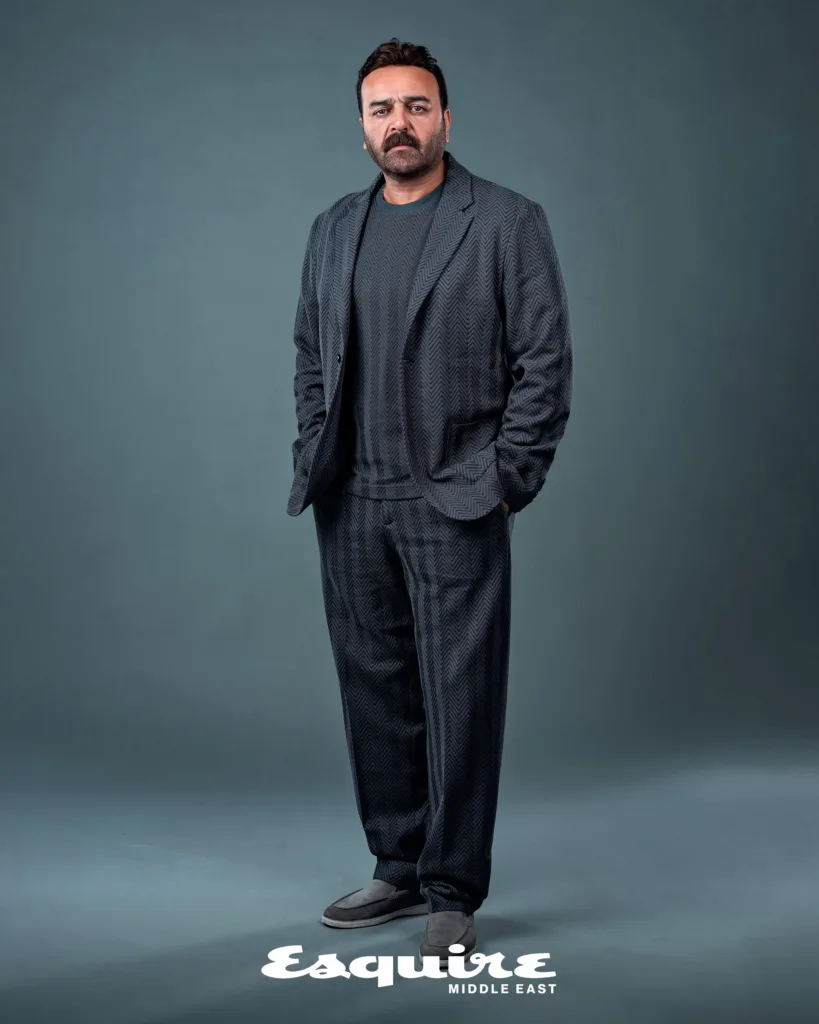
Samer Al Masri is one of the Arab world’s most acclaimed actors. From his breakout role as Colonel Abu Shehab in Bab Al-Hara to appearances in international films, the Syrian actor has captivated audiences across the region. With a career spanning decades and genres, he has become a symbol of creative versatility. Now at the height of his craft, he reflects on his journey, his work, and what comes next.
When I was a kid, I used to listen to a lot of classic songs, Umm Kulthum, Abdel Wahab. I could feel the emotions in their voices, and I started translating those feelings into school plays. That’s when I realized my passion was acting.
It wasn’t an easy path. I studied English literature because acting wasn’t considered a serious or stable career. But I found ways to bring performance into everything I did, until my faculty head told me, “You belong on stage.”
My parents weren’t supportive. My father kicked me out when he found out I had joined the theatre school. They thought I was wasting my potential.
Tragedy turned into luck. One night, after being thrown out, I was hit by a car. The driver turned out to be an Italian tour guide who, by coincidence, offered me small acting jobs impersonating historical Syrian figures for tourists. That’s how I began earning money and funding my theatre studies. It taught me how to rely on myself.
My defining roles? Colonel Abu Shehab in Bab Al-Hara (2006) gave me everything: recognition, love, legacy. Abu Janti (2010) gave me something else: laughter, surprise, and the freedom to be human and silly at once. Those two roles defined an era. But sometimes I wonder if they overshadowed the rest. People still stop me and say, “You’re Abu Shehab.” That means something; it means the performance lived on. But I hope they’ll also remember the roles that took more from me, even if they weren’t as famous. People think I’m defined by two roles. Maybe I am. But I don’t want to be. I want my legacy to be bigger than any single character. That’s why I keep going.
Comedy isn’t easy. Abu Janti was one of the hardest characters I’ve ever played. It carried humour, drama, and realism together. Behind that smile was a lot of weight.
Acting in English was tough. Arabic is home; it flows naturally. English forced me to rebuild from scratch. When I played Hassan in The Misfits (2021) alongside Pierce Brosnan and Tim Roth, I was testing myself to see if my talent could stretch that far.
I’ve always admired Tim Roth. When I met him, I couldn’t separate the fan from the actor. When we were prepping for a scene together in the back of a car, I asked for a photo; he refused. I was surprised. But he was deep in character; he didn’t want any distractions. Later, when we wrapped, he came up to me and said, “Now let’s take ten.” That taught me something about focus.
To grow as an actor, you have to push yourself: new languages, new industries, new risks. I didn’t want to stay inside the bubble of Arab drama forever.
If you asked me to choose between cinema and TV, I’d choose cinema. It lasts. It digs deeper. It leaves something behind. TV series travel fast, but cinema stays. There are roles that feed your artistic soul and others that feed your career. I try to balance both.
I don’t like show-off roles. I like complex, layered characters, the ones that take something from you and give something back.
I learn from my roles. In Nezouh (2022), which won two awards at the Venice Film Festival, I played Mutaz, a father refusing to flee his war-torn home. I learned from him how to hold on to my own beliefs, and how a father’s love can be both strength and weakness.
Syrian drama has a bright future, but we need a stronger structure. Before the war, our industry was at its peak: strong stories, great talents, high production quality. We still have all of that. What’s missing is a unified vision.
Streaming changed everything. You don’t need Hollywood anymore to be seen worldwide. Platforms like Netflix opened the doors. Now it’s about telling your story your way, in your language, in your rhythm, and staying true to your roots.
This stage of my life feels freer than ever. I’m taking risks I wouldn’t have ten years ago. Back then, I was too busy protecting an image. Now I care more about the work.
Fame? I don’t see myself as a famous person. If you start believing that, you’ll burn out. I’m just someone whose job happens to be on screen. I’m always open to meeting people; they come to say hi, take a photo. That’s part of the deal.
I’ve started my own production company, Ward Production. As an actor, you rarely control the stories offered to you. As a producer, you can finally create the ones you believe in.
Right now, I’m quietly working on a personal project, something close to my heart. I hope it sees the light soon. And maybe you’ll see me again in a Syrian drama for Ramadan 2026. People have missed that side of me.
