

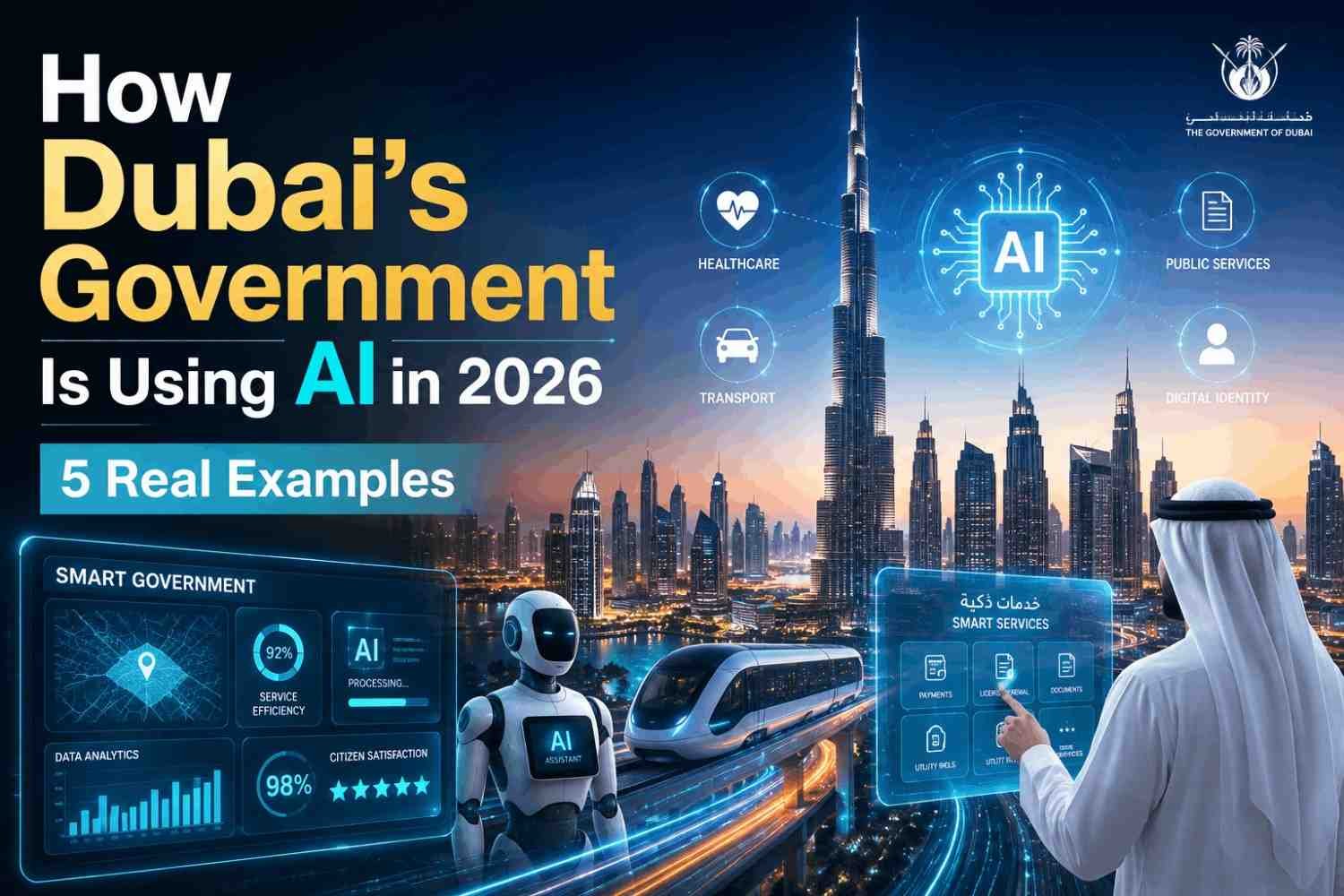
Dubai government AI adoption has accelerated sharply in 2026, moving beyond pilot projects into full-scale public services. From AI-powered autonomous taxis to a single unified digital platform managing an entire emirate, Dubai is positioning itself as one of the world’s most AI-driven governments. The push is not accidental. It is backed by the Dubai Economic Agenda D33, a citywide plan to double the size of Dubai’s economy that has also driven physical infrastructure upgrades like the New Dubai World Trade Centre bridge cutting travel time to just two minutes, and by direct instructions from Dubai’s leadership to treat AI as core infrastructure rather than an experiment. Here are five real, verified examples of how it is happening right now.
Background: How Dubai Got Here
Dubai’s current wave of AI adoption did not start in 2026. It builds on more than a decade of digital groundwork, starting with the original Smart Dubai initiative, which pushed government entities toward paperless services and shared digital identity through tools like UAE PASS. That foundation of connected data and digital services is exactly what makes today’s AI rollout possible. Without years of standardized data and unified logins already in place, an AI-powered platform covering every government entity at once would not be realistic. What changed in 2026 is the shift from digitizing services to making those services intelligent and proactive, which is really the essence of Dubai government AI as it stands today.
1. A Unified AI-Powered Digital Government Platform
In April 2026, Sheikh Hamdan bin Mohammed directed every Dubai government entity to merge its individual and business services into one unified digital platform within a year. This directive sits at the center of Dubai’s broader AI strategy for government services. The platform runs on integrated systems and shared data, so services respond proactively instead of reactively, flagging renewals, approvals, and paperwork before residents even have to ask. Behind it is an algorithm bank of production-ready machine learning models that entities can deploy without building AI tools from scratch, cutting development time from months to weeks. The stated goal is a city managed autonomously through data and AI, cutting friction for residents and businesses interacting with government services.
2. The AI Integration Matrix Framework
Digital Dubai released a whitepaper in April 2026 introducing the AI Integration Matrix Framework, developed under the Infrastructure and Operations Department. It was built to help government entities move from standalone AI experiments toward one coordinated, interoperable ecosystem. Instead of each department building isolated tools that cannot talk to one another, the framework gives every entity a structured playbook covering data standards, integration rules, and adoption stages. This framework is a key piece of how AI in Dubai government actually works at an operational level, ensuring new systems can communicate instead of creating disconnected silos across departments.
3. Training 50,000 Government Employees Through AI+
Digital Dubai launched the AI Workforce Transformation Program, known as AI+, to train 50,000 government employees in applying AI to their daily work. Delivered with the Dubai Government Human Resources Department and the Dubai Centre for Artificial Intelligence, the program is role-specific, with different job categories receiving different AI skill tracks rather than one generic course for everyone. This move recognizes that Dubai AI initiatives in 2026 cannot scale without a workforce that knows how to use the tools, not just entities that own them. A platform is only as useful as the people running it day to day.
4. AI-Powered Autonomous Taxis on Dubai’s Roads
Dubai’s Roads and Transport Authority launched commercial operations of autonomous taxis that use AI and deep-learning algorithms to make real-time driving decisions on public roads, not just in closed test zones. It is one of the most visible, public-facing examples of Smart Dubai AI adoption. Residents and tourists can now experience government-backed AI technology directly on the street rather than reading about it in a policy document, making it one of the clearest proof points that Dubai’s AI strategy extends beyond office systems into everyday mobility.
5. The Dubai Universal Blueprint for Artificial Intelligence
This is the strategic roadmap tying every other initiative together. The Dubai Universal Blueprint for Artificial Intelligence aims to contribute AED 100 billion annually to Dubai’s economy and raise productivity by 50 percent through AI-driven digital solutions, aligned with the Dubai Economic Agenda D33. It sets the direction for UAE government AI strategy at the emirate level, turning individual projects like AI+ and the Integration Matrix Framework into pieces of one long-term economic plan rather than disconnected announcements.
What This Means for Businesses and Residents
For residents, the shift means fewer manual applications, faster approvals, and services that increasingly anticipate needs instead of waiting for a form to be submitted. For businesses operating in Dubai, it signals that compliance, licensing, and reporting processes will keep getting faster and more automated, which also means outdated manual workflows on the private side will start to look increasingly out of step with how the city itself operates. Companies that align their own digital processes with this direction are likely to face less friction when dealing with government touchpoints going forward.
Challenges Ahead
None of this rollout is without risk. Merging every government entity’s services into one AI-powered platform within a year is an aggressive timeline, and questions around data privacy, system reliability, and equal access for residents less comfortable with digital tools remain open. Training 50,000 employees at different skill levels in a single program is also a logistical challenge on its own, separate from the technology itself. Dubai’s track record on digital transformation suggests these hurdles are being planned for rather than ignored, but the real test will be how smoothly the unified platform performs once it is live for the public rather than in government pilot testing.
FAQs About Dubai Government AI
How is Dubai’s government using AI in 2026? Dubai’s AI initiatives in 2026 include a unified AI-powered digital platform, an AI Integration Matrix Framework for government entities, a 50,000-employee training program called AI+, AI-powered autonomous taxis run by the RTA, and the Dubai Universal Blueprint for Artificial Intelligence.
What is the goal of Dubai’s AI strategy? The Dubai Universal Blueprint for Artificial Intelligence aims to contribute AED 100 billion annually to Dubai’s economy and raise productivity by 50 percent through AI adoption, as part of the wider Dubai Economic Agenda D33.
Which Dubai government department is leading AI adoption? Digital Dubai leads most initiatives, working alongside the Dubai Centre for Artificial Intelligence and the Dubai Future Foundation, plus entity-specific efforts like the RTA’s autonomous taxi program.
Is Dubai’s unified AI platform live yet? As of 2026, Dubai has directed all government entities to merge their services into one unified digital platform within a year, with rollout expected to continue through 2027.
How does Dubai’s AI strategy compare to other cities? Few governments worldwide have set a firm one-year deadline to merge all entities into a single AI-powered platform. Abu Dhabi is pursuing a similar path with its own AI-native government goal by 2027, making the UAE one of the most aggressive adopters of government AI globally.
Dubai government AI adoption in 2026 shows a shift from testing AI in isolated pilots to embedding it across every layer of public service: infrastructure, workforce, data, and long-term economic strategy. With deadlines like the one-year unified platform mandate now in motion, Dubai is on track to become one of the clearest real-world case studies of what AI-driven government actually looks like at scale, and one worth watching closely over the next twelve months as the rollout unfolds.
